⏱ 11 Minute Read
Last Updated: October 3, 2026
Who Shovels? Snow and Ice Removal Responsibility in Idaho Rentals
If you own a rental in the Treasure Valley, the short answer is this: Idaho has no statewide law that makes a landlord shovel, but your city almost certainly has an ordinance that makes the property owner responsible for the public sidewalk. In Boise, Meridian and Nampa, that duty sits on the owner of record. A lease can move the physical work to your tenant, and it usually should. It does not move the city's citation, and it does not reliably move an injured pedestrian's claim.
That distinction — the work versus the responsibility — is the whole post.
Idaho state law says almost nothing about snow
The core residential landlord-tenant provision is Idaho Code section 6-320, and it lists what a tenant can sue over: failure to provide reasonable waterproofing and weather protection, failure to keep electrical, plumbing, heating, ventilating, cooling and sanitary facilities in good working order, maintaining the premises in a way hazardous to the tenant's health or safety, security deposit failures, breach of a lease term materially affecting health and safety, and smoke detectors. Snow and ice are not mentioned. Neither is a driveway, a walkway, or a deadline.
Idaho's landlord-tenant statute is thinner than most states', and no state code section spells out winter maintenance. Do not read a snow duty into section 6-320 that is not there, and do not let anyone tell you the state sets a response time. It does not.
What the state does do is authorize cities to act. Under Idaho Code section 50-317, cities may have sidewalks and alleys cleared of snow, ice and rubbish and then assess the cost against the abutting private property. That is the hook. The bill lands on the parcel, which means it lands on the owner.
State law is silent, city code is not, and the city code runs to whoever owns the parcel. Everything else in this post is downstream of that.
What each Treasure Valley city actually requires
The rules are not uniform across the valley, and the differences matter if you own in more than one city.
| City | What the code requires | Deadline | How it is enforced |
|---|---|---|---|
| Boise | Every owner of a building or vacant lot must clear the sidewalks and gutters in front of the property while snow is on the ground, and keep them conveniently clear during the day (BCC 7-5-5) | By 9:00 a.m. each morning | Neglect or refusal is unlawful; penalties fall under the city's general penalty provision — confirm the current amount with the city |
| Meridian | Snow or ice on any public sidewalk abutting or adjoining privately owned premises is defined as an abatable nuisance (MCC 4-2-1) | Not stated as a clock hour in the definition | Notice from code enforcement, then abatement by the city with costs assessed; confirm the notice period with Meridian |
| Nampa | Property owners are responsible for maintaining adjacent rights-of-way, including sidewalks, curbs, gutters and removal of snow; owners and/or tenants are responsible for code compliance | Not published as a fixed hour | Complaint-driven code enforcement, notice to abate, then abatement and assessment |
| Eagle | Handled through the city's nuisance provisions; the city advises that clearing the walk in front of a home is the property owner's responsibility | Not verified in the published code | Nuisance abatement process — call the city before you rely on a specific deadline |
| Kuna | Sidewalk and right-of-way provisions sit in the city code, but a published snow-specific deadline could not be confirmed | Not verified | Contact the city directly |
If you want to read the source text yourself, the operative language sits in Boise City Code 7-5-5, in Meridian's nuisance ordinance (which lists snow or ice on a public sidewalk abutting private premises as an abatable nuisance), and in Nampa's code enforcement FAQ, which states plainly that owners maintain the adjacent right-of-way.
Two honest caveats. First, deadlines and penalty amounts are the most commonly mis-stated facts in snow articles; where a city has not published a number, this post does not invent one. Second, there has been public debate in Ada County about whether the highway district or the abutting owner is the correct party for public sidewalks. Cities have continued to enforce their ordinances against owners, so plan around the ordinance and check with your city if you get a notice you think is wrong.
Single-family versus multi-unit: a clean split
The practical answer changes with the property type, because the question underneath is always who controls the surface.
Single-family rental. The tenant lives there, is on site daily, and has exclusive possession of the yard, driveway and the walk in front. Assigning snow and ice removal to the tenant by lease is normal, reasonable and enforceable between you and the tenant. Give them the tools — a shovel and a bag of ice melt left in the garage costs less than one claim — and put the expectation in writing at move-in, not in January.
Duplex, fourplex, small multi-unit. Split it. Each tenant can reasonably be asked to clear their own private entry and patio. Nobody can reasonably be asked to clear the shared driveway, the parking bays, the walk to the mailbox cluster, or a common stairway, and you should not try. Those are areas the owner retains control of. Hire a vendor, set a trigger (commonly two inches or more, plus an ice-melt pass on freeze-thaw mornings), and keep dated service records.
Any property with a public sidewalk. The city ordinance duty stays with you no matter which of the above applies. The lease clause is your recovery mechanism against the tenant; it is not a defence against the city.
Owners who run one or two doors themselves usually handle this fine until the first February ice event. If you would rather it be somebody else's 6:00 a.m. problem, that scheduling and vendor management is part of what we handle for owners. It is also a standing piece of our Boise property management work, and it is one of the reasons the Boise homes for rent we list stay rented through a hard winter.
Slip and fall: where the real money is
The ordinance fine is not the exposure. The exposure is a fall.
Idaho premises liability asks whether the party in control used reasonable care in light of all the circumstances, whether they knew or should have known about the dangerous condition, and whether they failed to fix it or warn about it. For a landlord, the strongest claims are in the areas you kept control of — common walks, shared drives, exterior stairs — because there is no argument about who was responsible for them.
Fault is then apportioned under Idaho's comparative negligence statute. Recovery is barred only if the injured person's own negligence is as great as the defendant's; otherwise damages are reduced in proportion to their share. In plain terms: a visitor who walked across obvious glare ice in slick shoes may carry part of the blame, but "they should have watched their step" is a discount, not a dismissal.
Your tenant agreed to shovel. The UPS driver, the neighbour's kid and the plumber never signed your lease. They can name the owner directly, and in Idaho they can pursue the owner for the areas the owner controlled. A shoveling clause helps you argue fault allocation and, sometimes, seek indemnity from the tenant. It is not a shield, and no Idaho lease language reliably makes it one. Carry the insurance.
Two more things that shift exposure fast: partial clearing that refreezes into a smooth sheet is often worse evidence than doing nothing, and a vendor with no service log is a vendor who cannot help you prove you acted.
The lease clause to have in place before the first storm
Copy-ready language for a single-family Treasure Valley rental. Have your attorney review it against your form lease and your city.
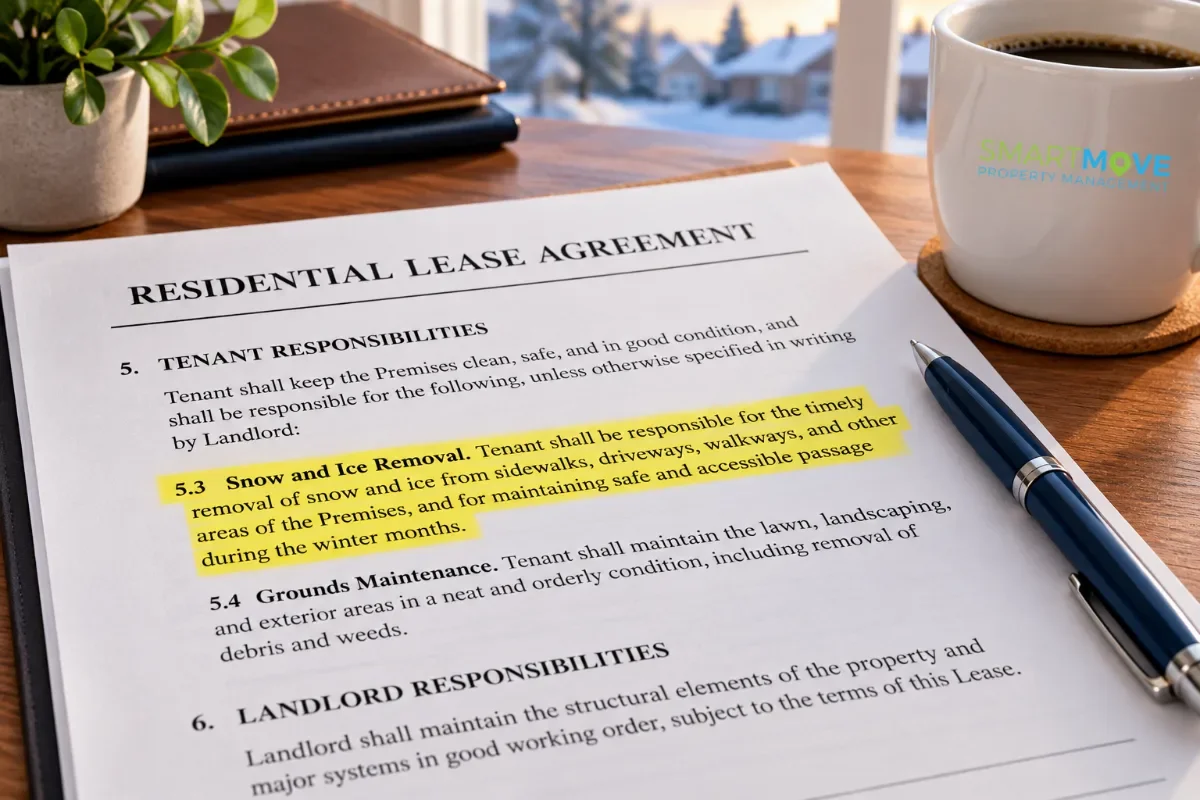
Snow and Ice Removal. Resident shall, at Resident's expense and as promptly as conditions allow, remove snow and ice from the public sidewalk abutting the Premises, the driveway, the walkway to the entry, and any steps or porch. On the public sidewalk, Resident shall complete removal no later than the time required by the applicable city ordinance. Resident shall not deposit snow or ice into the roadway or onto adjoining property. Resident shall promptly notify Owner of any condition Resident cannot safely address, including ice requiring treatment beyond ordinary ice melt. Owner may, after notice, perform or contract for removal and charge the reasonable cost to Resident. Owner retains responsibility for any shared or common areas identified in this Lease. Nothing in this section relieves Owner of duties imposed on the property owner by law.
Why that last sentence is there: it is honest, and honest is enforceable. A clause that purports to make the tenant liable for everything, including the owner's own negligence toward third parties, is the kind of over-broad waiver that courts look at hardest. Idaho will generally not enforce lease language that waives liability contrary to public policy, and it certainly does not rewrite a city ordinance. Ask for the work, not for immunity.
Three limits to know:
- It will not hold for common areas. If the surface is shared, the clause does not move the duty.
- It will not hold against the city. Code enforcement mails the owner of record.
- Mid-lease changes need notice. You cannot bolt a new obligation onto a fixed-term lease mid-year without agreement. On a month-to-month tenancy, Idaho Code section 55-208 governs changing terms by written notice — get the timing right rather than assuming.
Do HOA rules override any of this?
In a lot of Treasure Valley subdivisions, they effectively change the answer. Newer developments in Meridian, Eagle and Kuna frequently have an association that either contracts snow service for private lanes and common walks, or imposes its own clearing standard on every lot with fines attached. Under the Idaho Homeowner's Association Act, associations can assess for common area maintenance and enforce their covenants.
So the order of operations is: read the CC&Rs first, then the city ordinance, then write the lease. If the HOA already clears the walk, a tenant clause requiring the tenant to do it creates confusion and, occasionally, a tenant who salts a surface the HOA vendor just treated. If the HOA fines the lot for an uncleared drive, that fine comes to you.
- Confirm your city's ordinance and current deadline — Boise's 9:00 a.m. rule is not the valley standard.
- Read the CC&Rs and note what the HOA clears and what it fines for.
- Decide tenant-cleared or vendor-cleared for every property, in writing.
- Add or confirm the snow and ice clause in each lease before the first forecast.
- Send a one-page winter notice to residents with the clause restated and the city deadline.
- Leave a shovel and ice melt at each single-family door.
- Book the vendor for multi-unit properties now, with a two-inch trigger and dated logs.
- Verify your liability coverage and confirm the vendor's certificate names you.
- Photograph walkway condition at move-in and after the first storm.
- Save a repair path for ice caused by drainage, gutters or downspouts — that one is yours, not the tenant's.
The owner's takeaway
Idaho will not tell you to shovel. Boise will, by 9:00 a.m. Meridian will call it a nuisance and abate it at your cost. Nampa will put it on the parcel. And none of them care what your lease says.
Write the clause anyway — it assigns the work and gives you something to point at when a resident says nobody told them. Then handle common areas yourself and keep records. The owners who lose money on snow here are almost never the ones who got fined. They are the ones with no clause, no vendor log, and a visitor on the ground.
SmartMove PM manages single-family and small multi-unit rentals across Boise, Meridian, Nampa, Eagle and Kuna — including lease language, vendor scheduling and the documentation that matters when a claim shows up. If you want winter handled before the first storm, we are happy to look at your lease and your properties before the snow flies.
General information, not legal advice. Ordinances and statutes change, and enforcement practice varies by city — confirm your city's current requirements before relying on anything here, and talk to an Idaho attorney about your lease. Current as of September 2026.
Frequently Asked Questions
Is the landlord responsible for snow removal in Idaho?
Idaho has no statewide statute making a landlord shovel. The duty comes from your city. Boise, Meridian and Nampa all place sidewalk snow and ice on the property owner, and the owner of a rental is the landlord. A lease can hand the physical work to the tenant, but the city still looks to the owner of record.
Does Idaho Code 6-320 require a landlord to clear snow?
No. Section 6-320 lists weatherproofing, working heat and plumbing, keeping the premises free of health and safety hazards, and smoke detectors. Snow removal is not named. Idaho's residential landlord-tenant statute is unusually thin, so do not assume duties it does not create.
What does Boise's snow ordinance actually require?
Boise City Code 7-5-5 says every owner of a building or vacant lot must, while snow is on the ground, clear the sidewalks and gutters in front of the property by 9:00 a.m. each morning and keep them conveniently clear during the day. Neglecting or refusing is unlawful.
Can I make my tenant shovel in the lease?
Yes, in a single-family rental you can assign the work by lease, and most Treasure Valley owners do. What you cannot do is contract away the city's view of who owns the property, or guarantee that a lease clause defeats an injured visitor's claim against you.
Who shovels the common areas at a fourplex?
The owner, in practice and usually in law. Shared driveways, parking bays, breezeways and the walk to the mailboxes are areas no single tenant controls. Idaho courts expect a landlord to use reasonable care over areas the landlord retains control of, so put those on a vendor, not on a resident.
If a delivery driver falls on the walk, who gets sued?
Expect the owner to be named regardless of the lease. Idaho uses comparative negligence, so fault gets apportioned, and a tenant who agreed to shovel may share it. That is a claim you defend, not a claim the lease prevents.
Do HOA rules change any of this?
Often, yes. Many Meridian, Eagle and Kuna subdivisions have an HOA that either clears common walks and private lanes or enforces its own clearing deadline on each lot, with fines. Read the CC&Rs before you write the lease so the two documents do not contradict each other.
Should I hire a snow vendor or let the tenant handle it?
Single-family with a public sidewalk and no HOA service: tenant, with a written clause and supplies provided. Multi-unit, shared surfaces, or a property where a fall would be expensive: vendor, on a trigger like two inches or more, with dated service records.