Boise Short-Term Rental Rules for Owners: Licensing, Safety, & Lodging Tax
⏱ 11 Minute Read
Last Updated: October 9, 2026
This article is general information for Treasure Valley rental owners and is not legal or tax advice. It is current as of September 2026. Rules and rates change; confirm anything specific to your property with the City of Boise, the Idaho State Tax Commission, and your own attorney or CPA.
If you are weighing whether to list a Boise house on Airbnb or Vrbo, the headline is simpler than it was a year ago: you no longer need a City of Boise short-term rental license. The city repealed its short-term rental ordinance effective May 18, 2026, after the Legislature rewrote Idaho Code section 67-6539. But "no license" is not "no rules." You still owe state lodging taxes, you can still be held to a specific safety list, your subdivision's covenants still bind you, and every ordinary noise and parking ordinance still applies. Here is the whole picture, in order.
What actually changed in 2026
Two things happened, and they happened in that order.
First, the Legislature passed House Bill 583, which amended Idaho Code section 67-6539 and declared an emergency so the act took effect July 1, 2026. The rewrite classifies a short-term or vacation rental as a non-transient residential land use for zoning and building code purposes - the same category as an ordinary single-family home - and then spells out, in a long list, what a county or city may not impose on a property simply because it is rented short-term. You can read House Bill 583 as enacted in full; the operative language is short and worth twenty minutes of an owner's time.
Second, Boise City Council followed. On May 12, 2026 the Council approved repealing the city's short-term rental ordinance to align with the state change, with the repeal effective Monday, May 18, 2026. Per the City of Boise's short-term rental licensing notice, a city short-term rental license is no longer required, and existing licenses were valid through that date. The city also said plainly that it will keep enforcing applicable nuisance, noise, parking, safety and occupancy regulations consistent with state law and city code.
The permit went away. The obligations did not. Treat the repeal as a paperwork change, not a compliance holiday.
What a city or county can no longer require
Section 67-6539 now defines "different restrictions or obligations" as anything that would not be imposed but for a property's use as a short-term rental, and then lists examples. A county or city may not require:
- owner occupancy for any amount of time
- professional property management
- additional insurance
- reporting of use or other statistics
- additional fire protection or fire sprinklers
- additional or improved ingress and egress
- additional parking
- modification to the physical structure
- inspections
- internal or external signage, notices or diagrams
- a limit on the days a property can be rented
- notices to neighboring properties
- increased sewer or other utility capacity
- a conditional use permit in a residential zone
- limits on proximity to other short-term rentals
- a cap on the number of short-term rentals in the jurisdiction
- upgrades to current building codes that would not be required without the short-term use
The statute adds that no county or city shall require a license, fee, permit, certification or registration to operate a short-term rental. That is the sentence that ended Boise's licensing program.
What a city can still require
The preemption is broad but not total. Section 67-6539 lets a county or city require, by ordinance, exactly these safety measures and no more:
- Functioning smoke alarms in all sleeping areas, including basements, living rooms and family rooms when they are used for sleeping.
- A functioning fire extinguisher and a functioning carbon monoxide detector on each floor.
- Removable escape ladders in every above-ground-floor sleeping area that has a window.
- Maximum occupancy limits that do not exceed the non-transient residential limits in the international building codes adopted by the Idaho building code board.
- An easily accessible informational handout for guests describing exit locations, fire extinguisher locations, any supplied first-aid kit locations, and a phone number for the owner or manager in an emergency.
Separately - and this is the part owners most often miss - the statute confirms that short-term rental properties, their owners and their tenants remain subject to all other county and city ordinances and penalties that apply to any other residential use, including noise, parking, nuisance, curfew and traffic regulations. A neighbor complaint about a 1 a.m. hot tub party is still a live problem, and Boise said explicitly it intends to keep enforcing on that front.
The handout is cheap, it is the item a city is most likely to adopt by ordinance, and it is the single best piece of evidence that you ran a careful operation if a guest is ever injured. One laminated page by the door: exits, extinguisher, first aid, your 24-hour number.
The taxes are where owners actually get caught
Licensing is gone. Lodging tax is not, and it is administered by the state rather than the city, so nothing about the Boise repeal changed it.
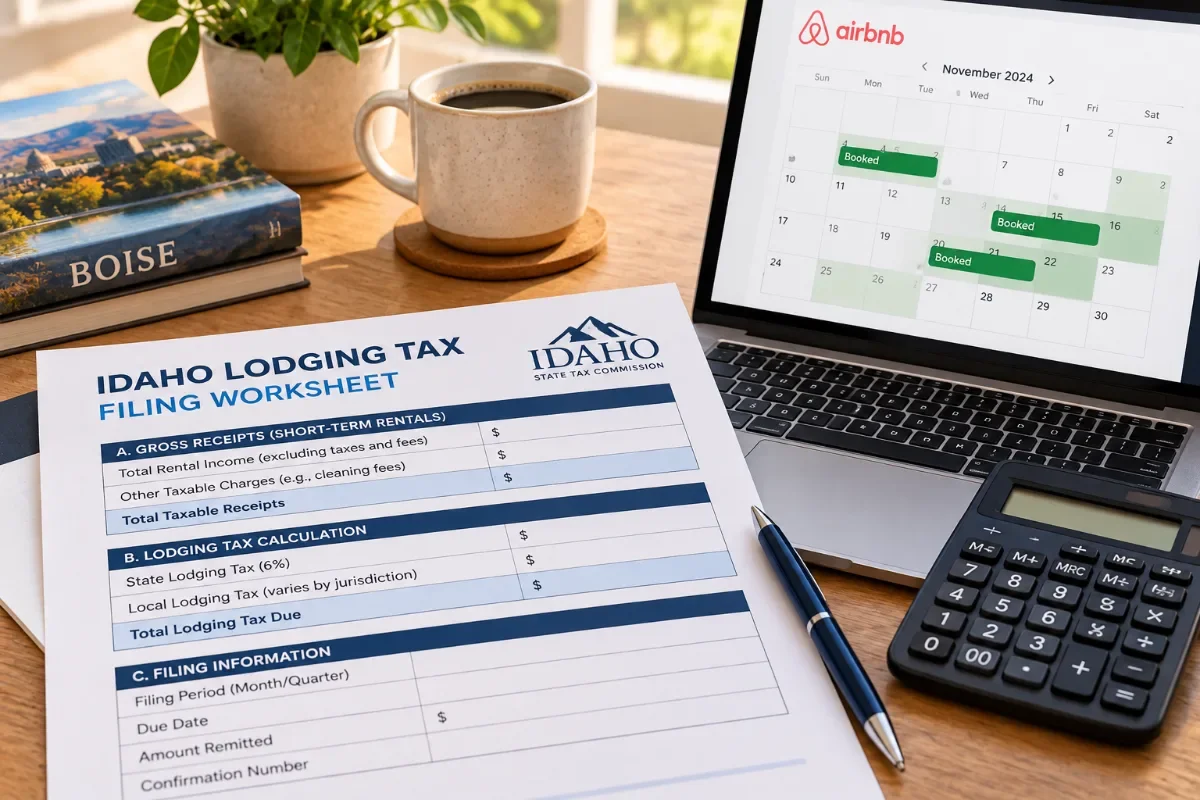
For a rental of 30 days or less, the Tax Commission's lodging tax chart shows that a vacation home, a cabin or a private residence owes all three of the state-administered taxes: Idaho sales tax, travel and convention tax, and auditorium district tax where the property sits in a district. Idaho's sales tax rate is 6 percent and the travel and convention tax rate is 2 percent. Auditorium district rates are set by district, so confirm yours rather than assuming.
That district question matters more in the Treasure Valley than most owners expect. The Tax Commission administers the tax for the Greater Boise Auditorium District, and - newly - for the Nampa Auditorium District as of April 1, 2026, per the auditorium district tax page. District boundaries follow addresses, not city limits, so a Meridian or Eagle property may or may not be inside one. The Tax Commission publishes address lookups for each district; use them before you publish a rate.
Permits you do still need
The Tax Commission lists three permits for a short-term lodging operator: a regular seller's permit, a travel and convention tax permit, and an auditorium district tax permit if you operate inside a district. You apply through the Idaho Business Registration and should have them in roughly 10 days.
There is one narrow exception. Technically you do not need those permits if you rent out lodging only through short-term rental marketplaces that collect and send in the taxes for you. The moment you rent by any other means - your own website, phone, email, a repeat guest texting you - or you charge for services or fees the registered marketplace does not tax, you need the permits.
Who collects: you or the platform
Idaho draws a clean line, set out in the Tax Commission's guide to rental marketplaces. If a marketplace arranges the booking, the marketplace registers as a retailer and collects, reports and forwards the tax on that stay. If you arrange the booking directly with the guest, you are the retailer and the obligation is yours. Owners who do both carry both roles at once: report your direct bookings, and do not re-report what the platform already reported.
House Bill 583 also amended Idaho Code section 63-1804 on this point, requiring a short-term rental marketplace to register with the Tax Commission for sales and use and travel and convention taxes and applicable local taxes it administers - and providing that an owner who rents directly, without a marketplace, must comply with the same requirements the marketplace would.
Your filing frequency is based on sales volume; monthly filers are due by the 20th of the following month, so an October return is due November 20. The Tax Commission is explicit that you file even if you made no sales. Off-season months with no bookings are exactly when owners forget, and penalties do not care that the number was zero.
Your HOA is a separate problem
This is the gap that surprises Eagle, Kuna and south Meridian owners most. The new statute restrains counties and cities. It does not rewrite the private covenants recorded against your subdivision.
Idaho Code section 55-115 provides that no homeowners association may add, amend or enforce a covenant, condition or restriction in a way that limits or prohibits the rental of property within its jurisdiction, for any amount of time, unless the owner of the affected property expressly agreed in writing at the time of the addition or amendment. That is real protection against a board that decides this year to ban nightly rentals. It is a weaker answer when a restriction was already recorded and applied to the property when you acquired it.
Practically: pull your recorded CC and Rs and read the use and rental provisions, check the board minutes for any rental amendment and when it was adopted, and pay a real estate attorney for an hour if anything is ambiguous. An HOA dispute discovered after your first guest checks in costs far more than that hour.
Before you list: an owner's checklist
- Confirm current city requirements with the City of Boise Clerk, or with Meridian, Nampa, Eagle or Kuna for those addresses. Do not rely on a blog post - including this one - for the version in force on the day you list.
- Install and test smoke alarms in every sleeping area, plus an extinguisher and CO detector on each floor.
- Add escape ladders to above-ground sleeping rooms with windows.
- Set your occupancy cap to the building-code figure for non-transient residential use, and write it into your listing.
- Post the guest safety handout with exits, extinguisher, first aid and a 24-hour phone number.
- Look up your address against the auditorium district maps.
- Register through the Idaho Business Registration for the seller's permit, travel and convention permit and district permit if you take any direct bookings.
- Decide your booking channels deliberately, and document which stays the platform taxes and which you tax.
- Read your CC and Rs.
- Call your insurance agent. A standard landlord or homeowner policy often will not cover transient occupancy, and the state preemption stops a city from requiring extra coverage - it does not make your carrier pay a claim it never underwrote.
- Confirm with your lender and, if the property is financed as an owner-occupied or conventional rental, check the occupancy terms in your note.
Short-term operation is a hospitality business attached to a house: turnovers between stays, guest communication at all hours, consumables, linens, higher wear, and a tax return every month whether or not anyone booked. Price the labor and the vacancy you will actually carry before you compare it to an annual lease.
Where this leaves Treasure Valley owners
The 2026 changes moved Idaho from a patchwork of city permits to one of the most permissive short-term rental frameworks in the country. For an owner that is genuinely simpler - fewer forms, no annual license, no conditional use hearing in a residential zone. But the obligations that remain are the ones carrying money and liability: the three lodging taxes, the monthly filing, the safety equipment, the covenants on your own deed, and an insurance policy that matches how the house is actually used.
What has not changed is the operating reality. A nightly rental is a different business from an annual lease, with different cash-flow behavior, different wear, and a compliance calendar that runs every month of the year.
SmartMove PM manages long-term rentals across Boise, Meridian, Nampa, Eagle and Kuna, and we are glad to talk an owner through the trade-offs honestly - including the cases where nightly rental really is the better call for a particular house.
If a long-term lease is the direction you land on, our team handles marketing, screening, maintenance and compliance across the Treasure Valley. Our Boise property management page shows what that looks like day to day, and the owner services page walks through reporting, communication and what we handle on your behalf.

Frequently Asked Questions
Do I need a license to run a short-term rental in Boise?
Not from the city. Boise City Council repealed its short-term rental ordinance effective May 18, 2026, and a City of Boise short-term rental license is no longer required. The repeal followed Idaho House Bill 583, which amended Idaho Code section 67-6539 and bars counties and cities from requiring a license, fee, permit, certification or registration to operate a short-term rental. You do still need state tax permits if you take bookings directly.
What can a city still require of a short-term rental owner?
Idaho Code section 67-6539 now lets a county or city require only a short, specific safety list: functioning smoke alarms in all sleeping areas, a functioning fire extinguisher and carbon monoxide detector on each floor, removable escape ladders in above-ground sleeping areas with windows, occupancy limits no stricter than the building code allows for non-transient residential use, and an accessible handout showing exits, extinguisher and first-aid locations and an emergency contact number. Separately, all the ordinances that apply to any other home - noise, parking, nuisance, curfew and traffic - still apply to you.
What taxes do I owe on a short-term rental in the Treasure Valley?
For stays of 30 days or less, the Idaho State Tax Commission lists three taxes on a vacation home or private residence: Idaho sales tax, the travel and convention tax, and an auditorium district tax if the property sits inside a district's boundaries. Idaho's sales tax rate is 6 percent and the travel and convention tax rate is 2 percent. Auditorium district rates vary by district, so confirm your rate and your address with the Tax Commission before you set a rate card.
Does Airbnb or Vrbo handle the taxes for me?
Partly. The Tax Commission treats those platforms as short-term rental marketplaces, and a marketplace must register as a retailer and collect, report and forward the tax on bookings made through its platform. If you also take direct bookings by phone, email or your own website, you are the retailer on those stays and must register, collect and file yourself. Owners who do both have to keep the two streams separate and avoid re-reporting what the platform already reported.
Which permits do I apply for, and how?
The Tax Commission says a short-term lodging operator needs a regular seller's permit, a travel and convention tax permit, and an auditorium district tax permit if you operate inside a district. You apply through the Idaho Business Registration and should receive them in about 10 days. Technically you can skip them if every single booking runs through a marketplace that collects and remits for you, but the moment you rent by any other means, or charge fees the marketplace does not tax, you need them.
Can my HOA stop me from listing the house on Airbnb?
Possibly, and the new state law does not solve it for you. House Bill 583 restrains counties and cities, not private homeowners associations. Idaho Code section 55-115 says no homeowners association may add, amend or enforce a covenant that limits or prohibits rental of a property unless the affected owner agreed to it in writing at the time it was added, but a restriction that already applied when you bought is a different question. Read your recorded CC and Rs and ask a real estate attorney before you list.
Do Meridian, Nampa, Eagle and Kuna have their own short-term rental rules?
They are bound by the same state limits as Boise, so none of them can require a permit or license to operate. Each can still enforce the narrow safety list and its ordinary noise, parking and nuisance ordinances. Taxes differ by address rather than by city: Nampa properties sit in the Nampa Auditorium District, whose tax the Tax Commission began administering April 1, 2026. Check your specific address against the district maps.
How do I file and pay the lodging taxes?
You file through Taxpayer Access Point on the schedule the Tax Commission assigns based on your sales volume. Monthly filers are due by the 20th of the month after the period, so an October return is due November 20. File even in months when you had no bookings - a zero return is still a return, and missed filings are the most common way an otherwise compliant owner picks up penalties.